Atradius Atrium
Get direct access to your policy information, credit limit application tools and insights.

 Group
 Australia
 Austria
 Belgium
 Bulgaria
 Canada
 China
 Czech Republic
 Denmark
 Finland
 France
 Germany
 Greece
 Group
 Hong Kong SAR
 Hungary
 India
 Ireland
 Italy
 Japan
 Lithuania
 Mexico
 Netherlands
 New Zealand
 Norway
 Poland
 Romania
 Singapore
 Slovakia
 Slovenia
 Sweden
 Switzerland
 Turkey
 United Arab Emirates
 United Kingdom
 United States

The updated Atradius Country Risk Map offers a concise snapshot of current risk levels across 189 countries and territories where Atradius provides country risk analysis to support international trade decisions.
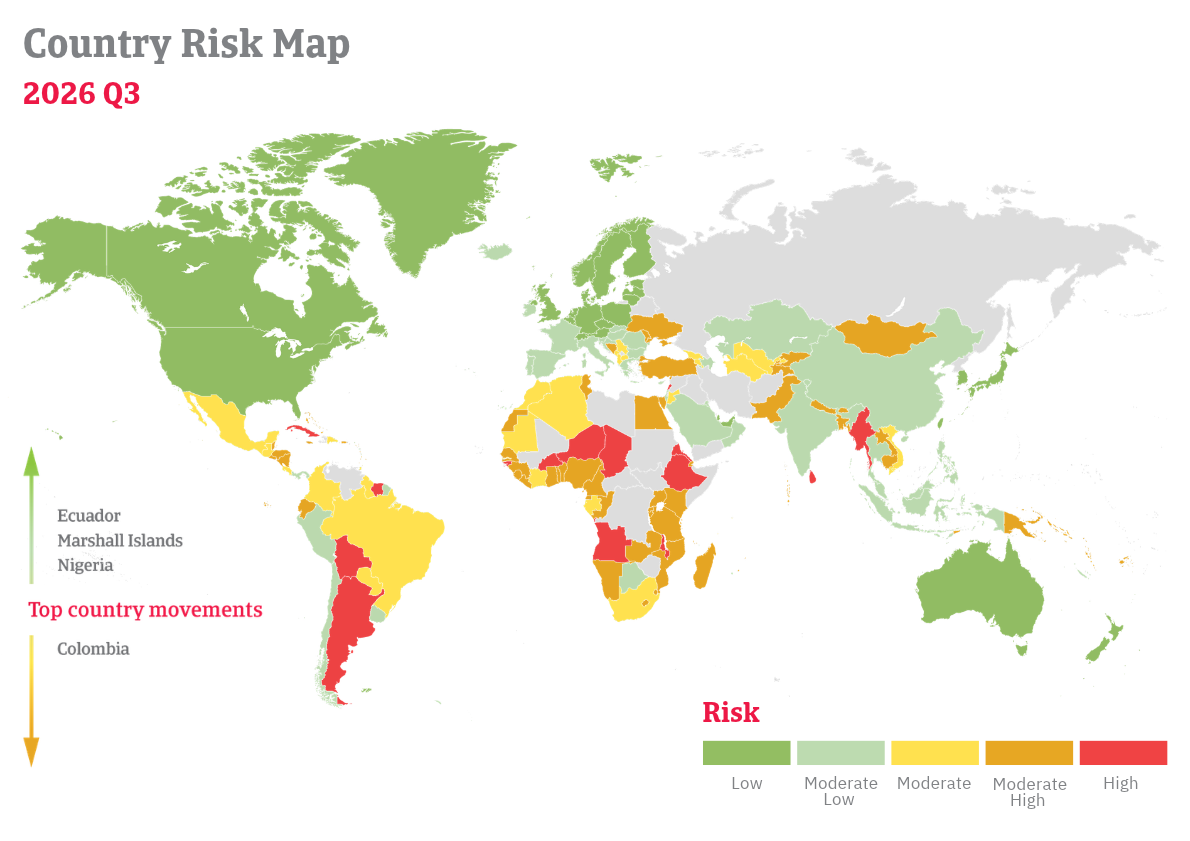
Of these, 79 are classified as low risk and 26 as moderate risk, while the largest group, comprising 84 economies, falls within the high-risk category.
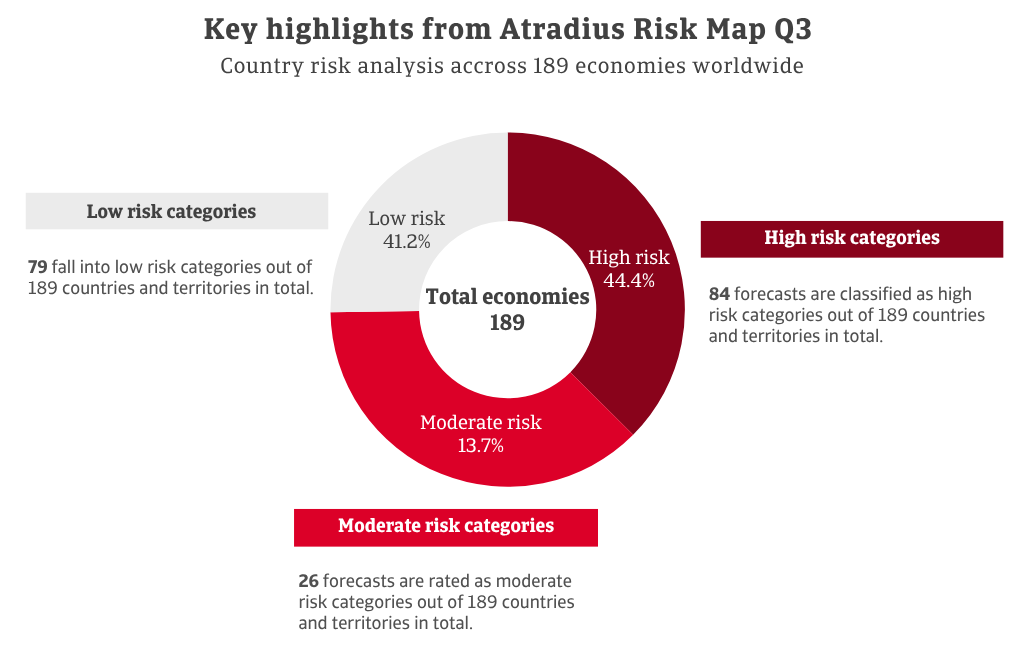
These findings underline the continued importance of risk management in international trade. Country risk ratings provide valuable insight into the broader business environment. Successful trading decisions require both country-level intelligence and an understanding of individual buyers, as opportunities and risks exist in every market.
The latest assessments reflect conditions at the end of Q3 2026. Risk ratings have been upgraded for Ecuador, the Marshall Islands and Nigeria, while Colombia has been downgraded.
Persistent fiscal deficits weakened confidence in Colombia’s public finances and triggered sovereign rating downgrades
According to Dana Bodnar, Senior Economist at Atradius, “Ecuador’s risk profile has improved as fiscal consolidation, IMF-backed reforms, and renewed market access have strengthened government finances and external liquidity. Continued policy implementation supports the country’s payment capacity, although its history of default still warrants caution.”
Commenting on Colombia’s downgrade, Bodnar said: “Persistent fiscal deficits have weakened confidence in public finances and triggered sovereign rating downgrades. Expectations of more business-friendly policies following the election have improved sentiment, but political fragmentation could slow reform efforts and keep payment risks elevated.”
On Nigeria, Bodnar noted: “The country has been upgraded as reforms, including exchange-rate liberalisation, subsidy removal and tighter monetary policy, have improved macroeconomic stability and foreign exchange availability. However, security risks, social pressures and weak public finances remain significant constraints.”
The Atradius Risk Map provides a global view of country risk levels, based on assessments by our Economic Research Team. Using the STAR rating system, it evaluates political and economic risks, civil unrest and conflict to help businesses navigate uncertainty with greater confidence.
Our interactive Risk Map allows users to explore risk levels country by country. Each profile includes key macroeconomic indicators, the STAR rating, ESG metrics, and expert insights into sector performance.
For companies trading internationally, a stable business environment is essential. Adverse developments can erode profits, disrupt operations, and undermine investment decisions. Monitoring both the level of risk and how it evolves is therefore critical, but it is only part of the picture. Ultimately, payments depend on the financial strength and reliability of end customers.
Credit insurance supports this process by assessing potential buyers before relationships begin and by continuously monitoring risks. To learn how these insights can strengthen your credit risk strategy, speak to our team, and discover how we can help you stay ahead.
To explore how to strengthen your own credit risk strategy, get in touch with us and see how we can help you stay ahead.