Atradius Atrium
Get direct access to your policy information, credit limit application tools and insights.

 Group
Group
 Australia
 Austria
 Belgium
 Brazil
 Bulgaria
 Canada
 China
China
 Czech Republic
 Denmark
 Finland
 France
 Germany
 Greece
 Group
Group
 Hong Kong SAR
 Hungary
 India
India
 Ireland
 Italy
Italy
 Japan
Japan
 Lithuania
 Mexico
 Netherlands
 New Zealand
 Norway
 Poland
 Portugal
 Romania
 Singapore
 Slovakia
 Slovenia
 Spain
Spain
 Sweden
 Switzerland
 Turkey
 United Arab Emirates
 United Kingdom
 United States

Fans hope the 2026 World Cup will be a feast of football. Organisers are eyeing a revenue generating opportunity of unrivalled proportions. If forecasts are accurate, this summer’s tournament could be the most lucrative sporting event the world has ever seen.
Partly, that’s down to the sheer scale of the event. The expanded tournament will feature 48 teams, up from 32, playing 104 matches across three host countries: the US, Mexico, and Canada. For FIFA, the body that organises the World Cup, this means more broadcast rights to negotiate, more tickets to sell, and more sponsorship inventory to monetise.
The results will be table-topping. In its most recent financial report, FIFA said that it expects to make USD 13 billion in the four-year cycle leading to this World Cup, of which around USD 9 billion will be made this year. By contrast, the Paris Olympics generated USD 5.2 billion in 2024.
Whatever happens on the pitch, this is one match FIFA seems certain to win, with no extra time and penalties required. There will be other impacts too. The worlds of football and economics interlink in a multitude of ways. In this article, we’ll dig deeper into the crossover between money, economic growth, and the beautiful game.
According to IMF projections, the participating nations account for around two thirds of global GDP. The US is at the top of the table, accounting for 26.2% of the total. Cape Verde (population 491,000) contributes just 0.003%.
There is a clear link between economic development and World Cup qualification. Of the more than 200 national teams that entered qualification in 2023, only 48 reached the finals. Around two‑thirds of these are high‑income or upper‑middle‑income economies, while roughly one‑third are lower‑middle‑income countries. Only a handful fall into the United Nations’ least‑developed category.
From a country risk perspective, the picture adds another layer of insight. According to our assessment, 24 participating countries fall into the low-risk category, 11 are moderate risk and 13 are high risk. This suggests that although stronger economic fundamentals support qualification, elevated risk profiles are not a barrier to competing on the global stage.
The top footballing nations are decent sized developed or emerging economies, suggesting success arises from a balance of footballing culture, investment in infrastructure, and luck.
Famously, all it takes for a football match to break out is a ball and jumpers for goalposts, but building competitive national systems depends on long‑term investment in infrastructure, coaching, and talent development. Financial resources do not guarantee success, but they create the foundations for it.
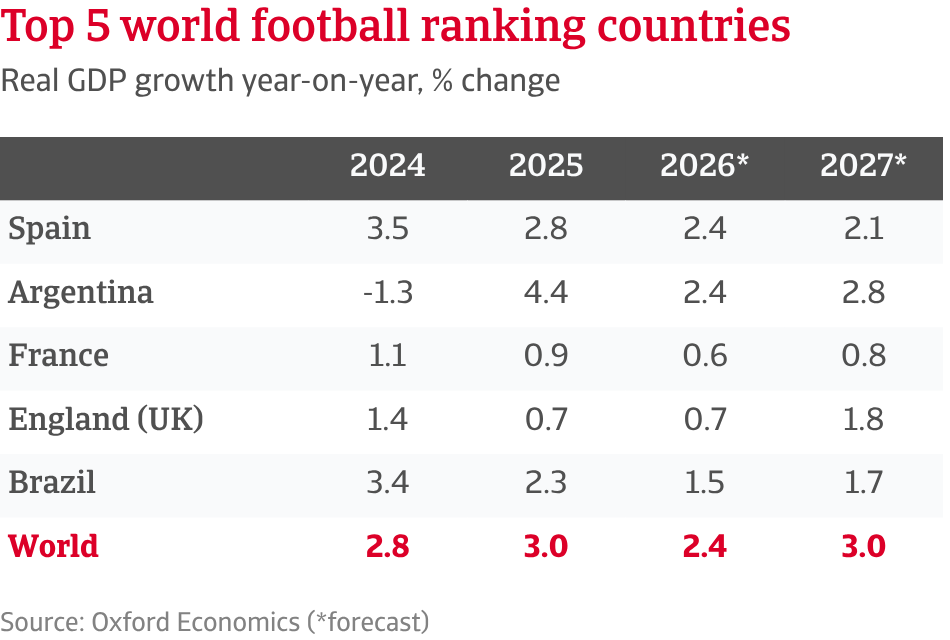
According to ELO rankings, the top five footballing nations heading into the World Cup are, in order, Spain, Argentina, France, England, and Brazil. The first team on the list from beyond the football heartlands of Europe and South America is Japan at 13.
In other words, the top footballing nations are decent sized developed or emerging economies, suggesting success arises from a balance of footballing culture, investment in infrastructure, and luck. In terms of nominal GDP, Spain is at 14th in world rankings, Argentina is 24th, France is seventh, the UK (of which England is only one part, albeit the largest) is fifth, and Brazil is tenth.
To flip that round, the US tops the table for nominal GDP, but is 41st in the ELO football rankings. China, second in terms of GDP, failed to qualify for the World Cup. Germany is the country that perhaps most consistently combines economic and footballing excellence, boasting the world's third largest economy and, currently, its 11th best football team.
.2026-06-03-08-17-56.png)
Ranking well is one thing, winning a World Cup another entirely. When we look at winners, a couple of things stand out. Only eight different countries have taken home the trophy, and six of them have won it more than once. Brazil holds the record for World Cup triumphs with five, followed by Germany and Italy with four apiece. Argentina has won it three times, Uruguay twice and England and Spain once.
Again, the message here is that you don’t need to be a top tier economy to win World Cups, but you can’t be at the bottom of the GDP league. There’s a sweet spot between economic power and footballing passion and prowess.
How do you get the balance right? That’s the code everyone wants to crack. England is an interesting example. The second biggest economy (currently) among past World Cup winners, it only boasts one victory, and that came 60 years ago. England’s Premier League is the richest football league in the world, with matches screened globally. Will economic factors, wedded to a passionate football culture, finally combine to give the country its second World Cup success? England is among the top favourites for this year’s tournament, together with Spain and France.
Countries tend to fight over the right to be World Cup hosts, in the hope that football can volley local and national economies into another league. Unfortunately, it’s not quite that simple.
First the good news. FIFA and World Trade Organisation (WTO) figures suggest the 2026 tournament could contribute up to USD 40.9 billion in GDP globally and underpin the creation of nearly 824,000 full time equivalent (FTE) jobs. Optimistic forecasts calculate that the impact on the US economy could be around 0.1% of GDP.
Then there’s longer term or more intangible benefits. Hosting a World Cup is prestigious. It can boost the health and happiness of nations by encouraging participation in sport. After tournaments, new infrastructure can be repurposed for the use of local communities, creating economic benefits - though that’s less true this time because very little new infrastructure was required.
But as the old football cliche goes, this is a game of two halves. The last time the US hosted the tournament, in 1994, researchers calculated that host cities suffered a cumulative economic loss of up to USD 9.3 billion. There are growing concerns that this year’s host cities will suffer a similar fate, amidst reports that hotels are slashing room rates as hoped for demand fails to materialise. High air fares and ticket prices are being blamed for the shortfall.
There are some unique circumstances at play. Economies are undermined by trade tariffs and conflict in the Middle East, and individuals have less disposable income. But the bigger picture isn’t surprising. Research from the University of Toronto has found that 12 of the last 14 World Cups resulted in economic losses for host cities. The costs of organising the competition tend to outweigh any boost to tourism, hospitality and local prestige.

There is another way for economies to make significant gains from the World Cup, however, and that’s by winning it. A study from the University of Surrey in the UK found that winning the tournament can increase GDP by up to 0.25 percentage points in the two quarters following the triumph. The rise is mainly driven by an increase in exports, suggesting that World Cup triumph creates a halo effect around the winning country’s goods and services.
Even participating in a World Cup can drive economic growth in connected sectors, though this can be a double-edged sword. Hospitality businesses are most likely to benefit, as fans pack into pubs and clubs to watch matches. Bricks and mortar stores might see reduced footfall as consumers watch matches rather than shop.
Beyond the World Cup, football has been shown to have significant economic benefits for local communities and national economies. In the 2023/24 season, England’s Premier League and its teams generated GBP 9.8 billion (EUR 11,3 billion) gross value added (GVA) and supported 100,000 full-time equivalent jobs. According to the German Football League DFL for every EUR 100 generated by clubs, an additional EUR 203 in value is created in non-football sectors.
Despite the connections between football and economics, two of the world’s new economic powerhouses - China and India - have not even made it to the finals. The US, the world's largest economy, has little chance of winning. These are GDP giants but not traditional centres of the game. For now, they lack the complete framework for success.
Several Asian and African teams are considered world class and could spring a surprise. But the trophy is again most likely to be lifted by a country from Europe or South America. These nations have a long footballing heritage and a history of investment in the game. Of course, money can’t guarantee that your striker slots home a 90th minute winner, but 20 years of top coaching, good pitches and advanced equipment can certainly tip the odds in his favour.
During the tournament we’ll be exploring the link between football and economics on LinkedIn, with weekly pre-match posts providing economic and sector insight on two of the competing countries. Follow us here.