Atradius Atrium
Get direct access to your policy information, credit limit application tools and insights.

 Group
Group
 Australia
 Austria
 Belgium
 Brazil
 Bulgaria
 Canada
 China
China
 Czech Republic
 Denmark
 Finland
 France
 Germany
 Greece
 Group
Group
 Hong Kong SAR
 Hungary
 India
India
 Ireland
 Italy
Italy
 Japan
Japan
 Lithuania
 Mexico
 Netherlands
 New Zealand
 Norway
 Poland
 Portugal
 Romania
 Singapore
 Slovakia
 Slovenia
 Spain
Spain
 Sweden
 Switzerland
 Turkey
 United Arab Emirates
 United Kingdom
 United States
After increasing by 1.4% last year we expect global construction output to grow by the same amount in 2026, one percentage point lower than our forecast earlier this year. Our lowered forecast is due to a more sluggish sector performance in both China and the US, weighing on the global construction outlook. Growth in advanced economies is predicted to increase by 0.8%, while building activity in emerging markets will rise by 2.8%.
The domestic nature of the construction market and relatively regionalised supply chains mean that construction has been more insulated from US tariffs and global trade uncertainty than other industries. However, the conflict in the Gulf and the blockage of the Strait of Hormuz have caused energy prices to surge, putting upward pressure on inflation. This has knocked business confidence and is impacting business investment in major construction projects.
Global residential construction output growth is expected to slow down to 0.8% this year. This is because interest rates in many economies remain elevated and household purchasing power is suffering from higher energy prices. All this weighs on housing demand. In 2027 a 3.0% rebound is expected, mainly driven by higher activity in Europe and North America. Housing shortages in many developed countries will need to be addressed.
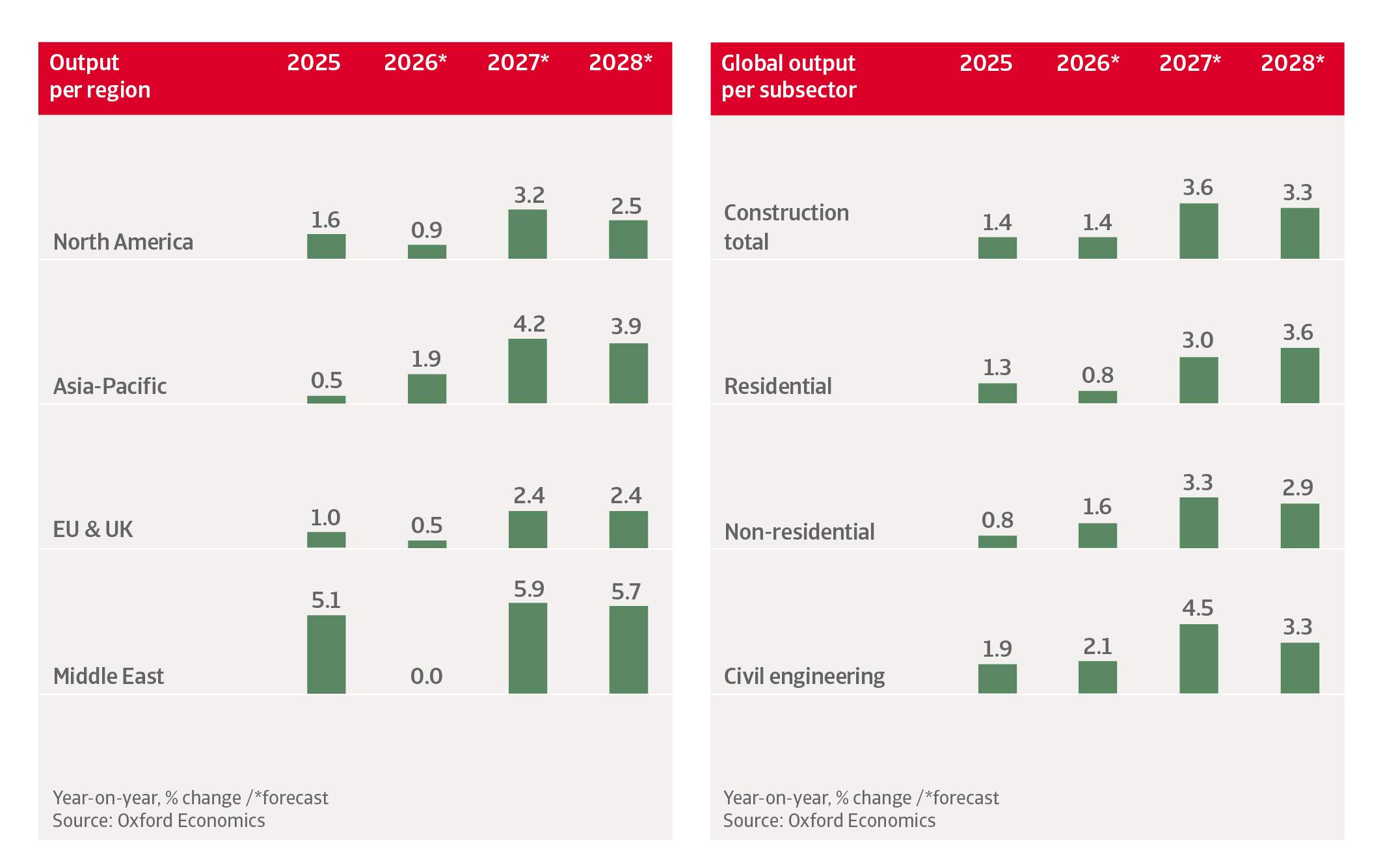
Non-residential building has decelerated to 0.8% and has also been impacted by inflation and a tighter monetary stance. This is knocking business confidence and reducing business investment in major construction projects. In 2027 a 3.4% rebound is expected amid lower interest rates and an economic recovery.
The global civil engineering sector is forecast to grow 2.1% in 2026, followed by a 4.5% increase in 2027. While fiscal consolidation in some countries affects infrastructure construction, others use fiscal expansion to build roads, railways, bridges, tunnels, and power grids, as well as other infrastructure. Energy security and the green transition also remain a focus for many governments. As countries work towards climate targets, infrastructure spending will continue to shift from transport projects to utilities in advanced economies.
Shortages of skilled construction labour and high labour costs are structural issues affecting many advanced economies. This is strongly impacting profit margins and delivery deadlines. Labour shortages and wage costs are particular issues for builders that work with fixed contract prices and are unable to pass on extra costs. After prices of construction materials surged throughout 2022 and 2023, construction firms hope that the downward pressure on prices continues. However, in general construction costs tend to be sticky; they can rise rapidly but are slow to retreat.
We expect US construction output to grow by just 1.1% year-on-year in 2026, after a 1.8% increase last year. Monetary policy is not expected to stimulate activity this year as borrowing costs remain elevated for the time being. High energy costs are weighing on the sector, and targeted tariffs on key construction inputs including steel, aluminium, and copper are disproportionately affecting the industry. The Producer Price Index for construction materials remains higher than before the recent inflationary period. The construction labour market is tight. Project costs are rising to meet higher wages, negatively affecting companies that have a lot of fixed price contracts. The current policy to curb immigration and implement more deportations is exacerbating labour shortages in the industry. Illegal immigrants account for about 15% of the US construction workforce.
We have downgraded the industry recently, and expect more payment delays and business failures in the coming months
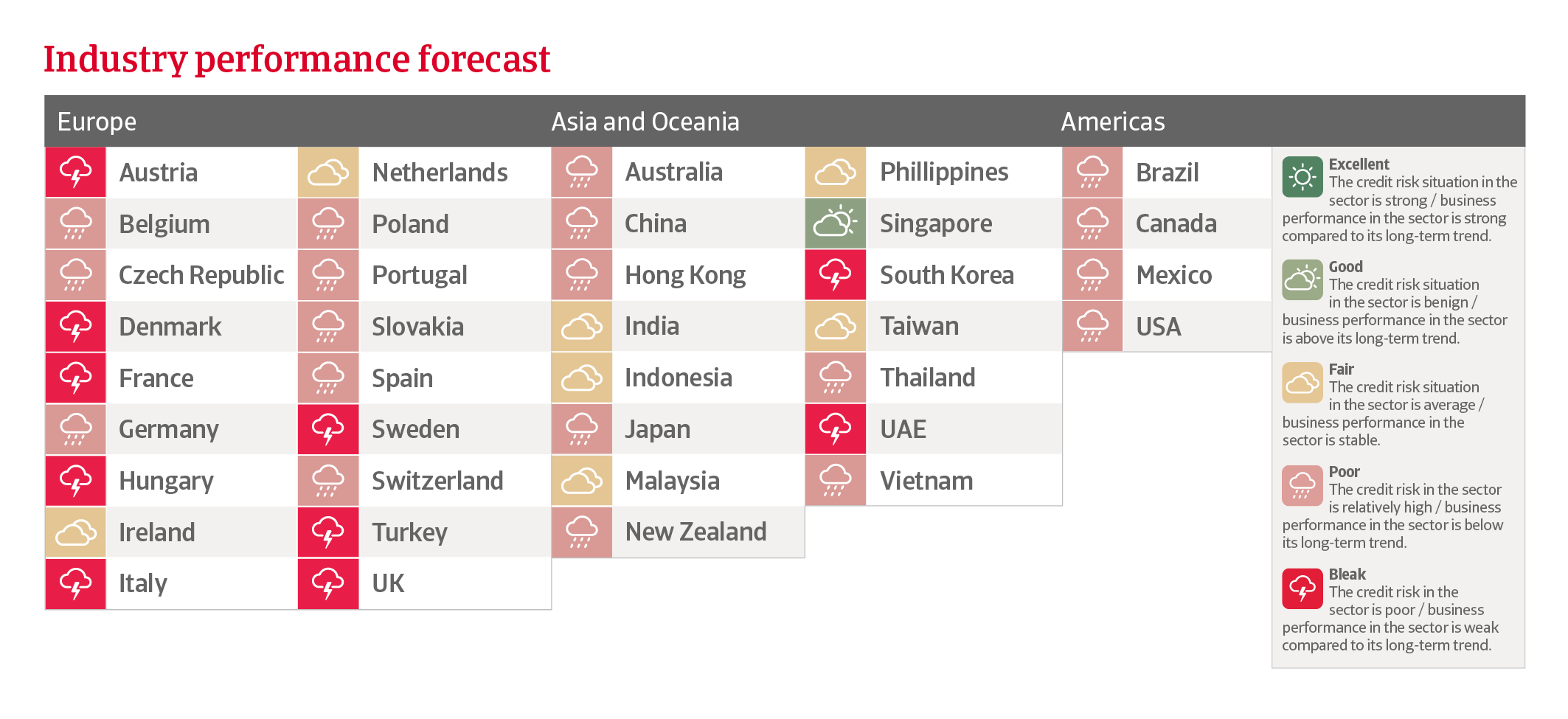
Due to those issues and their negative effect on profit margins, we have recently downgraded the business performance/credit risk situation of the industry from “Fair” to “Poor”. We expect more payment delays and business failures in the coming months. The sector has historically operated with long payment times compared to other industries. A cash flow crunch is continuing to intensify for certain businesses with heavy working capital needs and many are still paying high interest rates on their borrowing. Some companies are holding high levels of inventory and accounts receivable, placing pressure on cash flows. This could lead to liquidity constraints if they cannot secure adequate financing from lenders.
After growing by 0.9% in 2025, residential construction output is expected to increase by 1.0% in 2026. Mortgage rates are expected to remain above 6%, depressing housing demand. An oversupply of apartments in some regions and high inventories of unsold homes prompt developers to delay building. That said, businesses operating in the repair/remodel space and specialty construction materials segments are holding up better. They are more resilient in the continued elevated interest rate environment and find it easier to refinance upcoming debt maturities.
Non-residential construction is expected to contract by 0.8% this year after growing 0.3% in 2025. The US trade policy continues to hamper and delay business investments in new factories or office buildings, with only the largest projects likely to proceed. The uncertainty is resulting in challenges for the industry with many firms reporting difficulty in assessing project viability, with investors often pausing while awaiting further clarity. While data centres are increasingly a driving force for the sector, currently they still remain a relatively small proportion of overall activity. A strong pipeline of data centre projects should bolster non-residential building prospects in the medium term.
Civil engineering performance remains robust, with output expected to grow by 4.1% in 2026 after a 5.7% increase in 2025. The subsector benefits from ongoing infrastructure investment and large megaprojects, especially tech data centres to fund the growth in AI demand. However, new civil engineering construction projects could be affected by budget constraints.
We expect a rebound of sector output of 3.1% in 2027 amid stronger economic growth, monetary easing and decreasing input prices. Residential and non-residential construction output are expected to increase by 3.4% and 1.9% respectively, and civil engineering growth will remain robust at about 4%.
After a 0.6% contraction in 2025 we expect Chinese construction output to rebound by the same amount in 2026. The residential construction segment is forecast to contract again this year, by 0.6%, due to weak sentiment and ongoing financial problems in the property sector. In the first half of 2026 infrastructure and property investment decreased by 2.4% and 18.0% year-on-year respectively. Policy stimulus and accelerated bond issuance remain critical to driving full-year growth expectations.
We expect construction output growth to accelerate to 4.4% in 2027, with a 2.1% rebound in residential construction. The 15th Five-Year-Plan (2026-2030) emphasises further industrial modernisation and infrastructure improvement. Here, transport, water, and energy projects are particular areas of focus. All this should benefit non-residential and civil engineering building prospects in the coming years. Output in both segments is expected to increase by 6.5% and 6.6% respectively in 2027.
The risk of payment delays and insolvency in construction remains above the industry average in China, especially for private contractors and real-estate developers. The latter are highly reliant on government support and will need access to financing channels such as commercial banks to help soften cash flow issues. Major state owned enterprises (SOEs) and groups are facing relatively low insolvency risks because of their systemic importance to national economic policy and strong support from state-owned banks. However, insolvency risk remains elevated for regional SOEs, which are highly dependent on local governments’ budgets and fiscal capacities. Both are under increasing pressure from Beijing amid tightening controls on local government debt.
After decreases in 2024 (-6%) and 2025 (-2.1%), Japan’s construction output is expected to contract again in 2026, by 0.8%. Higher energy costs and increased economic uncertainty are discouraging building investment. Non-residential construction is forecast to decline by 1.7% this year, as corporate earnings are squeezed and investment appetites are dampened. Fiscal policy will remain accommodative, but the outlook for civil engineering remains sluggish, with output expected to level off this year. In 2027 no substantial rebound is on the cards, and we have downgraded the sector´s business performance/credit risk outlook from “Fair” to “Poor”.
The industry is facing major long-term challenges, such as labour shortages, rising costs, and an ageing population. Japan’s population has already started to shrink, and the percentage of people older than 65 is expected to climb steadily through the rest of the decade. As most demand for new houses tends to come from people of working age, the growing share of elderly people in the overall population will subdue demand for residential building. Weak demographics are also not supportive of large infrastructure spending.
Construction demand is stable in Southeast Asia, partly driven by the major role played by government projects to improve infrastructure and energy development. Construction output in the ASEAN region is forecast to increase by 4.9% in 2026 and by 6.2% next year. In 2026 high building growth rates are expected for Indonesia (4.8%), Malaysia and Singapore (both 6.3%), and Vietnam (8.5%). Indonesia remains the largest construction market in the region, driven by population growth, infrastructure expansion and development of Nusantara (the new capital city). Over the next couple of years, AI and hyperscale data centres will drive Malaysia’s construction growth.
Construction output is increasing in Southeast Asia, but margins are under pressure and the industry is highly leveraged
Despite growth, construction industry margins are under pressure from competition and commodity prices. The industry is highly leveraged, often resulting in tight covenants or banking demands for secure collateral when seeking finance. In particular Thailand and Vietnam are experiencing an increase in payment delays and insolvencies, often caused by project delays and volatile materials pricing leading to liquidity shortages. In contrast, Singapore’s construction industry credit risk is low, as the country holds the highest possible sovereign credit rating of AAA from Fitch, S&P and Moody’s. In addition, the sector is supported by strong government infrastructure investments and a consistent pipeline of public projects.
Construction output growth across the EU and UK is expected to slow down to 0.5% in 2026 after growth of 1.0% in 2025. Higher energy prices are dampening the appetite for major construction projects and increasing the cost of those already underway or under consideration. Fiscal policies in many eurozone countries will tighten in order to reduce deficits, which will act as drag on infrastructure building in the coming years. Across the EU and the UK, material costs remain higher than in the past, and labour shortages are a structural issue. Both issues are negatively impacting the margins of builders. Credit risk for construction businesses remains high in most European markets.
We expect French construction output to contract again in 2026, by 1.1%, followed by a subdued rebound of just 0.7% next year. The industry currently lacks any major growth driver, and political uncertainty weighs on the outlook and business confidence, in particular budget negotiations and the upcoming presidential election in April 2027. Surging energy prices threaten to put more upward pressure on already elevated construction costs.
Activity in the residential construction subsector also remains subdued this year and is expected to decrease by 0.7%. The growth of new building permits has been losing momentum since March, and the slowdown is expected to intensify. The downturn in property developers' sales continues, further weighing on the outlook for residential construction activity. Civil engineering is set to decline by 1.5% this year, followed by a meagre 0.2% increase in 2027. Difficult fiscal choices were mostly avoided in the 2026 budget, but pressure to restrict government spending remains significant due to high fiscal deficits and public debt. Therefore, the medium-term outlook for government investment in infrastructure and other building activities is muted.
Due to the weak performance the level of protracted payments and insolvencies will remain high in the coming months. This is partly due to the structure of the industry (which includes many small businesses with weak financials). The business performance/credit risk outlook of the sector remains bleak.
Construction performance continues to be affected by Germany’s modest economic growth this year and high energy prices. Additionally weighing on the sector are complex approval processes and bureaucratic hurdles, along with increased prices for building materials and the ongoing shortage of skilled workers. After contractions in 2024 (-3.7%) and 2025 (-3.4%) we expect construction output to decrease again in 2026, by 1.6%.
Germany’s massive fiscal package should be a huge positive for construction activity, in particular much of the country’s infrastructure needs refreshing after significant underfunding in past decades. But concerns about the effectiveness of implementation and the ability of the market to deliver such a vast volume of work at short notice remain. Existing order backlogs must be cleared before new measures can take effect. This accounts in particular for civil engineering, which is forecast to contract again in 2026, by 1.9%. Labour shortages remain a serious constraint on the ability to deliver the pipeline of work.
Non-residential building should also benefit greatly from the fiscal package, particularly defence- and military-focused projects. But currently there are major downside risks, particularly the energy price shock and a subsequent hit to business confidence. Output in this subsector is expected to decrease this year, by 1.6%. Residential construction is forecast to decline by the same amount, as lower household purchasing power and inflation weigh on performance.
Currently credit risk remains high for the time being, in particular for small construction businesses. Many of them, with tight liquidity have extended their payment terms. Payment behaviour remains tense, and the level of construction insolvencies is still high.
That said, we expect that financial leeway created by the government’s special fund will gradually take effect. Therefore, we expect that German construction output will rebound by 5% annually in 2027 and in 2028, with robust growth rates along all subsectors.
After growing by 3.0% in 2025, construction output growth is expected to cool down to 1.5% in 2026 and 0.5% in 2027. A main reason is the expiry of Next Generation EU funding at the end of this year, of which mainly civil engineering and non-residential building have benefitted most. That said, a sizeable infrastructure pipeline linked to transport, energy and digital projects should help sustain overall sector activity and prevent a sharper downturn.
Producer prices have remained elevated since 2022 and energy prices have surged, which is impacting construction activity due to higher project costs. Lower government funding due to fiscal consolidation will affect civil engineering output over the coming three years, with annual contractions of about 0.5% expected. Ongoing business uncertainty is hampering non-residential building investment, while residential building growth will slow down to 1.6% this year and 1.2% in 2027.
Credit risk in the industry remains high due to fluctuating demand, liquidity shortages, reluctance among banks to provide loans and long protracted payments. SMEs in the residential segment are affected by high competition, pressure on margins and liquidity tensions. The situation is somewhat better for larger builders active in the civil engineering subsector. However, in this segment, exposure to late payments by public assignors (particularly for road and rail construction) is generating high DSOs, which are usually passed on to suppliers. Between 2023 and 2025, the insolvency rate among Italian construction companies has shown a concerning upward trend. We expect insolvency risk to remain elevated due to structural weaknesses and ongoing financial strains.
Construction output growth in the Netherlands is expected at 0.5% this year, followed by a 1.5% increase in 2027. Residential construction market forecasts point to a recovery in housing output, with annual completions potentially rising from around 68,000 homes in 2025 to between 74,000 and 84,000 by 2027. Growth is supported by a stronger project pipeline and improving permit issuance, although labour shortages, permitting constraints and grid congestion continue to limit the pace of expansion.
Dutch construction output continues to grow, but labour shortages, permitting constraints, grid congestion and high material costs limit the pace of expansion.
Non-residential construction remains more challenging. New office, retail and commercial developments are facing higher financing costs, grid capacity constraints and cautious investment sentiment. While new-build activity is expected to remain weak in 2026, refurbishment, energy-efficiency upgrades and technical building installations continue to create opportunities. A gradual recovery is anticipated from 2027 onwards. Civil engineering demand is being driven by investment in energy infrastructure, electricity networks, water management, climate adaptation and replacement of ageing assets. Growth in this segment is expected to range between 2% and 3% annually through 2027.
Structural challenges persist across all subsectors. These include labour shortages, nitrogen-related permitting restrictions, power grid congestion, lengthy planning procedures and rising material costs, all of which are constraining higher output growth. As a result, the outlook is positive but measured: demand is increasingly present, yet the sector’s ability to convert opportunities into completed projects will remain the key determinant of growth over the next two years.
We expect UK construction output to contract by 1.1% this year amid weak GDP growth, ongoing uncertainty about the government’s economic policies and persistently elevated interest rates.
The former administration announced plans to build 1.5 million new homes by 2030, but there are serious doubts that this target is achievable under current market conditions. We expect residential construction to contract by 0.5% this year before rebounding by 3.1% in 2027. Sustained wage growth and elevated energy prices are putting upward pressure on businesses’ costs. Weak profitability and heightened uncertainty hamper companies’ investment in building. We expect non-residential construction output to decrease by 1.6% in 2026, followed by a modest 0.4% rebound next year. Fiscal woes will limit room for civil engineering, which is now expected to decrease by 1.3% this year. In any case, a substantial future rebound of construction performance will be slow.
The increases in National Insurance Contributions and the national living wage are also impacting the ability of construction companies to hire skilled workers (the labour shortage is already a major issue). In the UK many new building projects continue to be delayed, due to legacy contracts, supply chain issues, price inflation, and delays in planning applications being approved. The rate of construction insolvencies peaked in 2024, at levels only comparable to the 2008 financial crisis. In the coming months we expect some further improvement, but the sector’s credit risk situation remains “poor”, with a still elevated level of payment delays and business failures.
Download the full report in the related documents section below.
To explore how to strengthen your own credit risk strategy, get in touch with us and see how we can help you stay ahead.