Atradius Atrium
Get direct access to your policy information, credit limit application tools and insights.

 Group
Group
 Australia
 Austria
 Belgium
 Brazil
 Bulgaria
 Canada
 China
China
 Czech Republic
 Denmark
 Finland
 France
 Germany
 Greece
 Group
Group
 Hong Kong SAR
 Hungary
 India
India
 Ireland
 Italy
Italy
 Japan
Japan
 Lithuania
 Mexico
 Netherlands
 New Zealand
 Norway
 Poland
 Portugal
 Romania
 Singapore
 Slovakia
 Slovenia
 Spain
Spain
 Sweden
 Switzerland
 Turkey
 United Arab Emirates
 United Kingdom
 United States

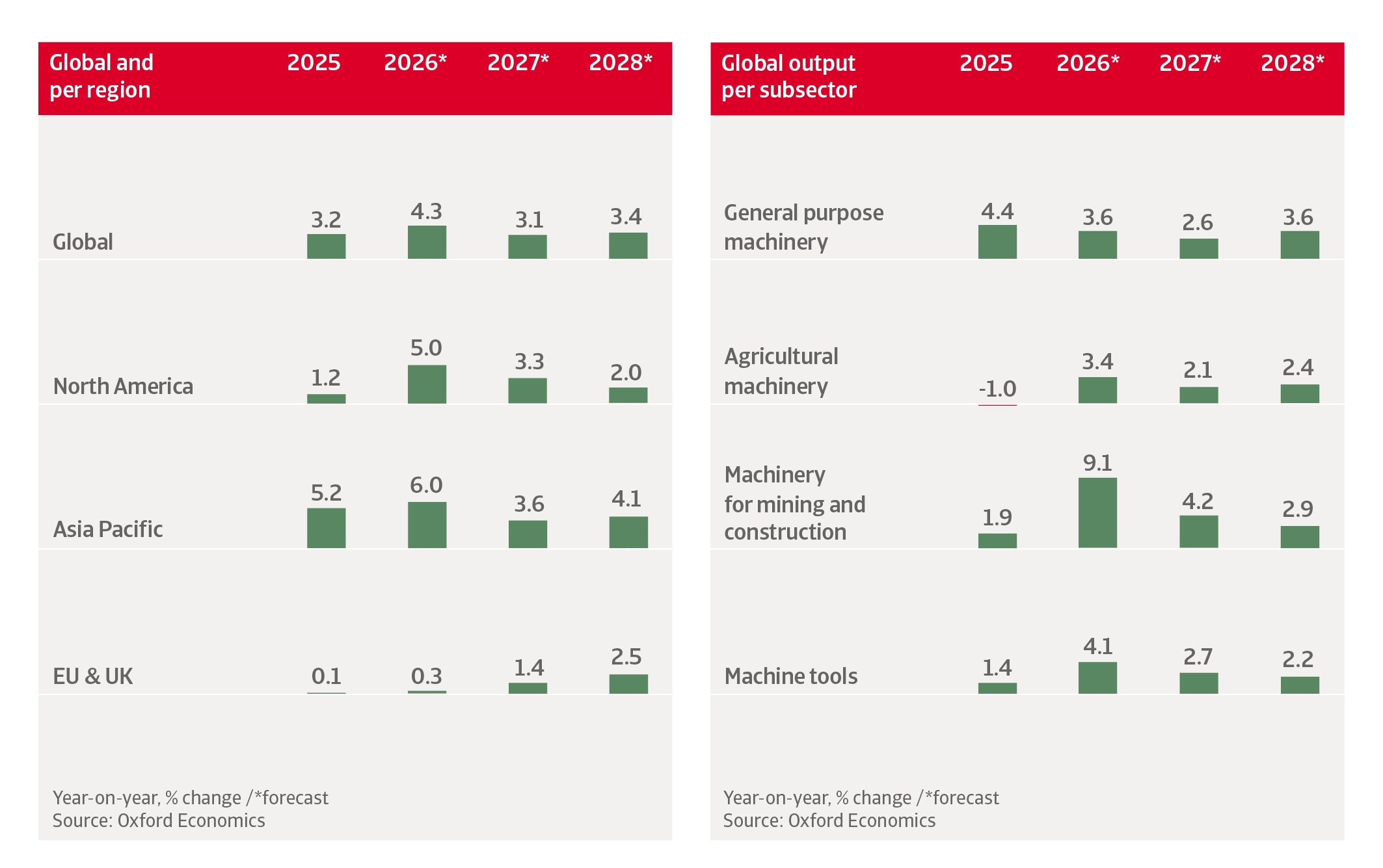
We expect global mechanical engineering output to increase by 4.3% in 2026, followed by 3.1% in 2027. After contractions in 2023 and 2024 the recovery is gaining momentum due improving capital expenditure.
Predicted 2026 and 2027 growth for the machines and engineering sector among the regions is strongest in North America and Asia Pacific (see chart overleaf). In the US machinery demand is growing due to ongoing robust AI-related capital expenditure, particularly in hardware and data centre construction. The expansion of data centre building is driving demand for turbines, generators, and other power-transmission equipment. The Asia Pacific machinery sector is benefitting from strong exports and technology investment, particularly across the semiconductor and electronics supply chains.
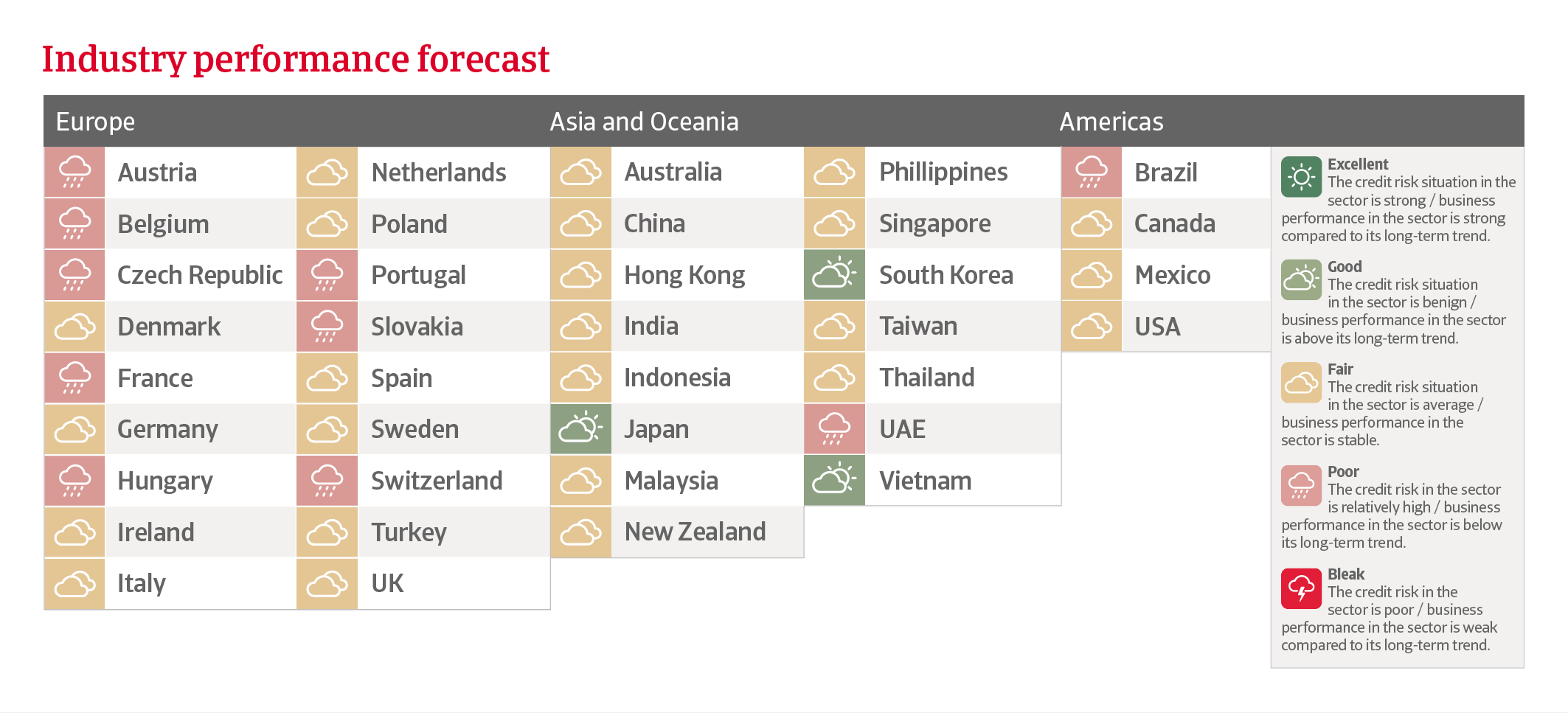
In Europe, sector performance is being held back by weak exports, elevated uncertainty, and energy-driven inflation. Tighter monetary policies in the region are hampering the ability of manufacturing companies to invest in machinery. The share of countries where the business performance and credit risk situation of the machines and engineering industry is rated “Poor” is quite high (see chart below).
Machinery is highly reliant on cross-border supply chains, and therefore very sensitive to changes in global trade policies. Confidence and security over strategic planning decisions are important for an industry that often requires financing for significant capital outlay, often over many years. Ongoing uncertainty about US tariffs and retaliatory measures remain an issue for the industry.
In the mid- and long-term, the shift towards electric vehicles will lead to changes in machinery supply to the automotive sector, with more emphasis on batteries and related electrical equipment. Demand for machinery to manufacture conventional powertrains will weaken. Across all regions, we expect sector growth to decelerate in the long-term. This mainly affects Asia Pacific, where China is reaching the limits of its investment-driven growth model.
We expect US mechanical engineering production to grow by 5.9% in 2026 and by 3.2% next year. After increasing by 8% in 2025, machinery and equipment investment in the US is set to grow by 7.8% this year. New order levels are at historic record highs, 53% higher than the levels seen a decade ago, with order intake in electrical machinery and apparatus having almost doubled. The main driver is ongoing robust AI-related capital expenditure, particularly in hardware and data-centre construction. Special purpose machinery output is forecast to increase by 7.4% in 2026 and by 4.2% in 2027. The expansion of data centre building is driving demand for turbines, generators, and other power-transmission equipment.
New orders for industrial machinery were up 36.0% year-on-year in Q1 of 2026, with shipments following at 34.0%. Despite persistent uncertainty over US trade policy and a lack of monetary easing, capital expenditure intentions remain firm, and investment is broadening beyond AI-related sectors.
Automation, aerospace and defence are also driving US machinery demand. The increase in global defence spending will benefit the US arms industry, given the dependency of other countries, in particular in Europe, on US defence equipment. The so-called One Big Beautiful Bill Act (OBBBA) includes some generous provisions for deducting the cost of machinery and equipment purchases. The extension of tax cuts and the increase in government spending (defence and non-defence) supports demand for US machinery across all subsectors.
While tariffs provide a tailwind for domestic machinery and equipment manufacturers, rising raw-material costs are creating pressure on the other side of the equation. Producer price inflation for machinery and equipment has increased since mid-2025. The sector has a relatively high use of metals as an input material to production. Steel and aluminium are still tariffed at 50%, which will continue to put upward pressure on input costs and weigh on competitiveness. And with a significant share of US companies still dependent on imported machinery and equipment, those pressures can quickly ripple through supply chains and squeeze margins. Against a backdrop of emerging softness in US financial markets, companies may also have less flexibility to absorb supplier price increases, making tariffs an increasingly important headwind to watch.
In the mid- to long-term, demand for automation, digitalisation, and sustainable production solutions in manufacturing should support machinery demand in the US. New technologies integrated in the manufacturing process and generative AI will increase productivity in the mechanical engineering industry.
We expect Canadian mechanical engineering production to decrease by 2.3% in 2026 after annual contractions in 2025 and 2024. The main reason is ongoing uncertainty about trade relations with the US and the future of the USMCA trading bloc. Exports to the US account for about 75% of Canadian machinery gross output, making it one of the most exposed sectors to US import tariffs. That said, higher defence spending should prove a tailwind for the industry in the future. We expect a machinery output rebound in 2027 under the condition that negotiations between Canada and the US will settle most trade issues, despite the current tensions. However, a failure of those talks would leave the sector on a permanently lower growth path.
After growing 7.0% in 2025 we expect Chinese mechanical engineering output to increase by 6.4% in 2026, followed by 4.2% next year. Growth is supported by a rebound of private capital expenditure and government investment in strategic sectors such as high-tech, automation, and climate/energy, mainly benefitting the electrical machinery segment. Robotics output is surging, with production up 29.4% and 44.2% in 2024 and 2025 respectively. Exports of machinery and equipment remain strong, and supported by its pricing power, China’s share in the global machinery market has steadily increased over the past couple of years. Machinery exports have expanded by 10.6% and 7.8% in Q1 and Q2 of 2026 respectively.
Despite solid growth, the sector is facing some issues. Its export strength is also the industry’s principal vulnerability, as its success is inviting protectionist responses, in particular from the US and Europe. At the same time the investment momentum remains uneven. Fixed asset investment linked to special equipment of solar PV, LEDs, construction and other sectors is facing excess capacity and remains under pressure. Investment growth in Q1 of 2026 decreased to 1.9% in universal equipment manufacturing and contracted 8.6% in special equipment manufacturing. Persistent oversupply continues to drive price-cutting, with producer prices for both special-purpose and universal equipment still in negative territory.
In the mid- and long-term we expect Chinese annual mechanical engineering output to stabilise between 2.0% and 2.5%, as China is reaching the limits of its investment-driven growth model. A shift to a more service-oriented economy will reduce demand for capital goods.
Japanese mechanical engineering output is forecast to increase by 3.7% in 2026 after a 1.4% contraction last year. The order book is strong and increasingly driven by external factors, led by demand for chip-making kit. Orders for semiconductor-making tools and electronic-component equipment spiked by 25.7% quarter-on-quarter in Q1 of 2026, a clear sign of spillovers from the AI investment boom. This is partly offsetting the drag on machinery demand caused by US tariffs. However, a weakening global trade environment remains concern for a sector that heavily relies on foreign markets.
Domestic market growth is lower than external demand, but still solid. Machinery orders are expected to increase by more than 4% in 2026, supported by GX (green transformation) related investment, equipment replacement and infrastructure renewal. The issue of labour shortages across all Japanese industries is driving demand for the automation segment in the machinery sector. Tax incentives should also provide additional support for domestic machinery demand.
The new Japanese government has approved a large budget focused on strategic industries and defence expansion, which should support medium-term investment in machinery. However, any fiscal slippage risks triggering higher government bond yields, raising financing costs and limiting the effectiveness of government support.
After contractions in 2024 and 2025 we expect mechanical engineering output in the EU and the UK combined to grow by just 0.3% in 2026. A better performance is being held back by soft global demand, weak exports, elevated business uncertainty, and an energy-driven increase in inflation. Tighter monetary policy in the eurozone is hampering the ability of manufacturing companies to invest in machinery. In the UK machinery performance is expected to contract by 2.3% this year. The main reason is a squeeze on domestic corporate profitability due to high energy costs, strong pay growth and higher employer national insurance contributions.
In contrast to the US, AI-related capital expenditure is not providing a boost in demand for related machinery items in Europe. Sales outside the region are a significant source of revenue for the industry, but there are issues. For example, European mechanical engineering exports are highly dependent on the US market, meaning the sector is exposed to higher metals and aluminium import tariffs. Competition from Asian machinery producers, in particular China, remains strong in export markets. Over the past five years the market share of EU global exports in machinery has declined markedly, while China’s has increased by more than 5% as its products have risen up in the value chain.
In 2027 we expect machinery output in the EU and the UK together to increase by 1.4%, due to a rebound in manufacturing activity in the region and interest rate cuts once inflation decreases. However, the issues in export markets will persist.
Germany accounts for more than 45% of eurozone mechanical engineering output. Machinery production and exports contracted in 2024 and 2025, and for this year we expect another output decrease of 2.4%. The sector remains stuck between low external demand and high costs. While machinery exports to the US have started to recover somewhat from last year’s tariff turmoil, deliveries to China are still decreasing. In the domestic market, the picture is mixed. Government equipment investment continues to expand, as a large fiscal package has been deployed. However, investment in machinery by the private sector remains subdued, held back by uncertainty, weak external demand, and tighter financial conditions. At least there are tentative signs of stabilisation, but downside risks remain.
Capacity utilisation in machinery and equipment is subdued at a 77.4%, and non-payments and insolvencies in the industry increased over the past two years. Demand from automotive as a key buyer industry is expected to decrease further, and for cost reasons German machinery manufacturers are increasingly relocating their production abroad. Competition from Chinese machinery producers is still growing in many export markets. For all those reasons, we expect credit risk in the German machinery sector to remain elevated this year.
There had been some expectations that the boost in German defence spending would benefit the machinery sector in the short term. However, orders have run far ahead of the defence sector's ability to fulfil them. They are now around five times higher than in 2022, which has added further pressure on a limited production capacity. Output, by contrast, has only roughly doubled since 2022, and the gap is piling up in backlogs, which have tripled.
Due to the limited capacity of the defence industry to scale-up production, the increase in machinery and equipment orders have not yet translated into a production surge.
We expect German machinery production to rebound by 0.6% in 2027 and by 2.7% in 2028 as defence procurement and infrastructure investment gain momentum, while business capital expenditure recovers.
Download the full report in the related documents section below.
To explore how to strengthen your own credit risk strategy, get in touch with us and see how we can help you stay ahead.