Atradius Atrium
Get direct access to your policy information, credit limit application tools and insights.

 Group
Group
 Australia
 Austria
 Belgium
 Brazil
 Bulgaria
 Canada
 China
China
 Czech Republic
 Denmark
 Finland
 France
 Germany
 Greece
 Group
Group
 Hong Kong SAR
 Hungary
 India
India
 Ireland
 Italy
Italy
 Japan
Japan
 Lithuania
 Mexico
 Netherlands
 New Zealand
 Norway
 Poland
 Portugal
 Romania
 Singapore
 Slovakia
 Slovenia
 Spain
Spain
 Sweden
 Switzerland
 Turkey
 United Arab Emirates
 United Kingdom
 United States
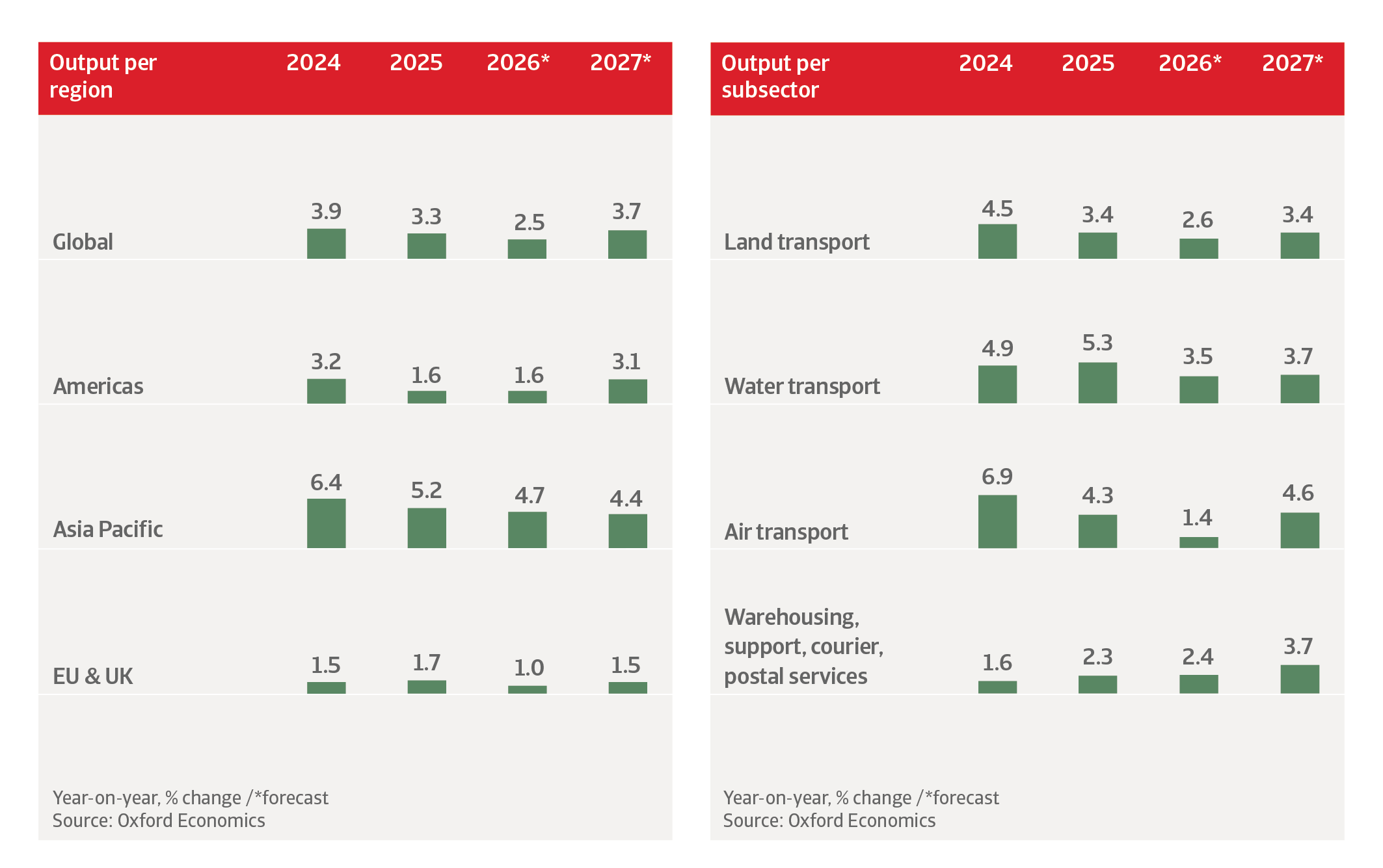
Before the outbreak of the war in the Gulf, we expected global transportation and logistics output to increase by 3.4% in 2026. However, we have now had to revise this forecast downward to 2.5%. The sector’s performance this year is affected by two major headwinds: firstly, global economic growth is slowing this year as high energy prices affect consumer sentiment and household purchasing power. Inflation-driven monetary tightening keeps borrowing costs high and weighs on investment. This is resulting in lower demand for freight and passenger transport this year.
Secondly, transport and logistics is extremely oil-intensive relative to other sectors. As such, falling demand has been compounded by sharply higher prices and reduced capacity. Recent developments suggest the conflict may be entering a fragile de-escalation phase. The key question is how quickly the Strait of Hormuz will reopen fully to traffic. Physical flows are still likely to recover gradually rather than immediately. The main constraint is likely to be shipping, insurance, and operational confidence rather than underlying oil production capacity. Risks over the implementation and enforceability over the US-Iran agreement and potential disagreements on longer term-issues mean oil and commodity markets will probably remain volatile in the coming weeks.
Air transport is the subsector most affected by the Gulf conflict, with the 2026 growth forecast revised down from 4.3% to 1.4%. We expect passenger flows across the Middle East to contract by 38% this year, a massive decline for a region that in past years has seen significant increases in both direct inbound travel and flights connecting Asia and Europe. Due to the major surge in jet fuel prices (up over 95% across the world) airlines are cutting flights, while travellers will forgo flying this year. That said, currently we do not assume that there will be damaging shortages of jet fuel in major travel hubs across Europe, North America, or Asia. Global refineries have sharply increased their production of jet fuel to take advantage of high prices, and governments have taken steps to expand the supply available.
In order to improve their supply chain resilience, businesses may need to keep greater levels of inventory as a safety buffer. As a result, we expect greater demand for warehouse storage facilities. At the same time the air freight segment is benefiting from high demand for time-sensitive delivery of goods and growing e-commerce.
Over the long term, we expect emerging markets in Asia Pacific, Africa, and South America to drive global transportation and logistics growth. This is particularly true for China and India, two of the world’s most populous countries that are investing heavily in infrastructure and transport networks.
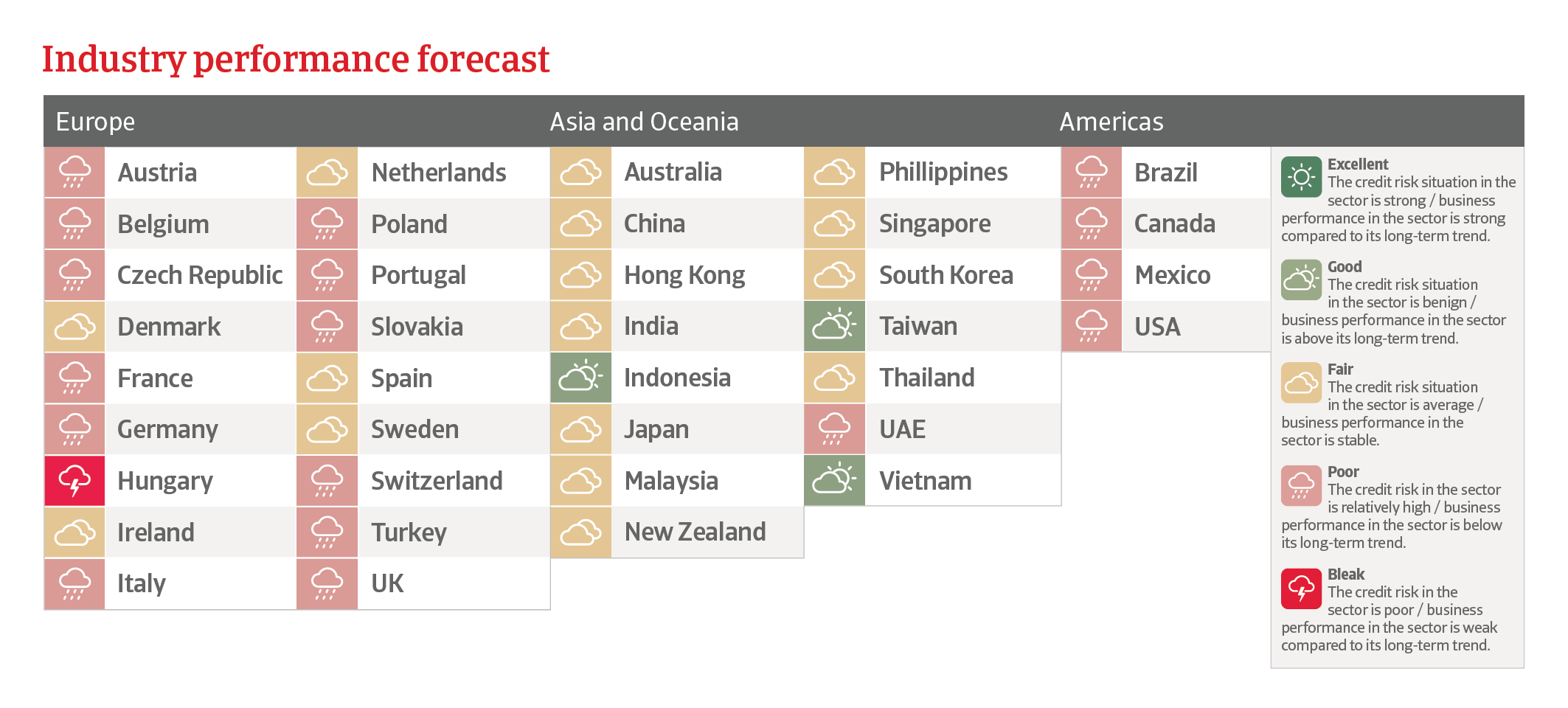
The US transportation and logistics industry is navigating a complex environment. After increasing 1.6% in 2025, we expect sector output to remain modest this year, growing 1.3%. Slowing trade growth, tariff-related uncertainty and softer import demand weigh on freight volumes, while higher fuel, insurance and compliance costs continue to squeeze margins across road, air and ocean freight businesses.
US port throughput growth will flatten in 2026, as tariff-related front-loading unwinds and trade policy uncertainty persists. An effective tariff rate of close to 10% continues to weigh on transpacific trade flows, suppressing near-term import demand. Additionally, higher freight costs and geopolitical disruptions further cap volumes.
Trucks are the key transport mode for goods in the US. Land transport is expected to grow only 0.8% in 2026, with the subsector constrained by weak demand due to a more sluggish industrial activity and softer consumer spending. Additional issues are tightening capacity and rising cost pressures. Declining long-haul truckload demand is only partially offset by resilient short-haul and e-commerce activity.
Weaker trade activity with Canada and Mexico is impacting trucking, which plays a vital role in cross-border trade under the USMCA framework. At the same time oversupply in trucking persists after Covid-era capacity expansion, constraining pricing and utilisation rates. Labour shortages are contributing to delays and rising costs, and the restrictive immigration policy could exacerbate this issue. At the same time, fuel prices - up about 50% as of May 2026 due to the US-Iran conflict - alongside higher insurance and regulatory costs, are increasing operating expenses and pushing up rates. In 2027 land transport is forecast to increase 2.8% as gasoline price increases should recede.
US air transport output is forecast to decline by 0.1% in 2026 after growing 3.1% last year. Rising fuel costs will increase air freight rates and volatility,
squeezing margins and limiting capacity growth. Overseas tourism performance remains muted, after total arrivals were already down by more than 5% in 2025. Demand for air transport will be supported by logistics needs for time-sensitive goods, perishable goods and high-value, lightweight products. However, Washington’s decision to end the de minimis exception for all parcels entering the US risks materially disrupting air cargo, particularly cross-border e-commerce. China-US e-commerce air cargo volumes have decreased by more than 50%.
In the mid-term, government investment in infrastructure improvement should benefit the sector by promoting greater supply chain efficiency, reducing costs, and stimulating demand for transportation and logistics services. Additionally, sector growth will be supported by rising US energy exports and reshoring initiatives under the Trump administration.
Chinese transportation and logistics output is forecast to expand by 4.8% in 2026 and by 4.9% in 2027, supported by steady industrial production, continued export diversification, and sustained domestic consumption recovery. Growth is expected to remain broad-based across land, water, and air transport, with all major subsectors projected to grow above 4% annually over the medium term.
China’s export sector continues to demonstrate resilience despite a more fragmented global trade environment. While geopolitical frictions and selective tariff measures remain a feature of global trade policy, their impact on China’s aggregate export performance has been partially offset by strong growth in trade with Southeast Asia, the Middle East, Africa, and parts of Europe. This ongoing reorientation of trade flows is reinforcing China’s role as a central node in global manufacturing networks, even as reliance on the US market gradually declines.
China’s ports remain among the world’s busiest and are likely to sustain high output in the coming years. This is due to increasing trade with emerging markets and ongoing innovation in port logistics. Air cargo benefits from continued advancements in logistics, and digitalisation will enhance operational efficiency, supporting growth and resilience. At the same time, China is moving up the value chain in global exports. High-tech manufactured goods, including electric vehicles, batteries, solar components, and advanced machinery, are increasingly important drivers of external demand. This structural shift is supporting more value-added logistics flows and increasing demand for specialised transport and cold-chain capabilities.
We expect the sector will benefit from government support for businesses and investment in infrastructure (domestic and international) in the coming years. Those investments show China’s ambition to ensure that it remains a major hub in global supply chains and logistics. The ongoing expansion of e-commerce is increasing demand for courier and storage facilities. Higher GDP per capita and rising household incomes will sustain demand for domestic transport services. Road freight volumes are expected to show annual growth rates of more than 3% in the coming five years.
Indian transportation and logistics output is forecast to grow by 8.9% in 2026 and by 7.1% in 2027. The government has introduced initiatives to boost the manufacturing sector by improving the business environment and enhancing logistics infrastructure. This includes the “Make in India” campaign which promotes the country as a manufacturing hub for both domestic and international companies. Expanded manufacturing capacity should support higher freight volumes in the mid-term. India’s growing middle class is spurring demand for consumer goods, supporting land, sea and air transport. However, even more investment in transport infrastructure is required to overcome existing inefficiencies and bottlenecks.
We expect Japan’s transportation and logistics output to grow by 3.6% in 2026 and by 2.3% in 2027. The transport sector has been remarkably resilient to various shocks in recent years and has consistently outgrown GDP. While Japan has faced macroeconomic and energy price headwinds due to the Gulf crisis, industrial growth should help provide a key tailwind towards the end of the year and into 2027. Inbound tourism, which powers a fair amount of transport sector growth, will remain robust, as the weak yen will continue to attract visitors.
After a 1.5% increase this year, we expect transportation and logistics output in the EU to slow down to 0.8% in 2026. The economic outlook for this year is subdued with a 0.4% growth rate. The region’s industrial recovery remains protracted, and higher energy prices are weighing on households’ real incomes, confidence, and spending. Exports are expected to be broadly flat, reflecting weak external demand, the lingering impact of US tariffs, the recent intensification of Chinese export competition, and continued losses in global export market share. All these factors impede demand for transport, while businesses suffer from increased fuel costs. A substantial upturn in transport and logistics output will have to wait until early 2027.
Within the eurozone Germany and France continue to be the regional laggards, with output contracting in both countries. Others, such as Greece and Spain, are performing better on the back of higher tourist demand and services growth. Both will continue to be the growth leaders in terms of transport sector output in 2026.
Business services across the region indicate that the price of transport services across different segments are set to rise. Transport and logistics businesses will try to pass on as much of the oil price shock as they can, but their ability to do so will be limited in a broadly tepid macroeconomic environment.
In Germany, the largest eurozone market, we expect transport and logistics output to contract by 0.3% in 2026, with decreases across all main subsectors (land, water, air transport). Sharply increased diesel prices have caused the situation to become increasingly strained. Many road freight forwarders must pay for diesel immediately, while customer invoices are not settled until 60 days later. Small and medium-sized enterprises are particularly affected by current price trends. Given margins of less than 3%, this pre-financing burden is causing significant problems for freight forwarders. Added to this are rising labour costs, an acute driver shortage, and fierce competition from Central and Eastern Europe. We estimate that one in four small and medium-sized freight forwarders is at risk.
For years, the logistics industry has been among the sectors with the highest insolvency rates in Germany—and a further increase in business failures is expected this year. Notifications of non-payment in the first few months of this year are already well above the comparative figures for the past five years.
We expect UK transport and logistics output to grow by 2.2% in 2026, with land transport up 1%. This increase is mainly due to high output in Q1, but performance has declined since then due to the impact of the Gulf crisis and subdued economic prospects. Higher energy prices have weakened private consumption, while business investment is held back by weak profitability and fragile confidence. Interest rates remain high, and fiscal policy is being tightened significantly. All this negatively impacts economic growth and related transport demand.
Next to lower demand, the UK haulage segment struggles with ongoing staff shortages, fierce competition and vehicle replacement expenses due to accelerating sustainability mandates. Current high fuel prices are also compressing profits for this already low-margin industry. Fuel typically represents about 30% of total haulage operating costs, and while cost hikes are felt immediately by service providers, contract pricing is renegotiated retrospectively. This can lead to margin shortfalls and cashflow gaps for hauliers, increasing credit risk in a segment already characterised by financial distress.